A Multimodal Deep Learning Framework for Early Detection of Congenital Heart Disease in Neonates
DOI:
https://doi.org/10.33387/ijeeic.v2i2.10059Keywords:
CHD, Multimodal, Data, Fusion, AI, Deep LearningAbstract
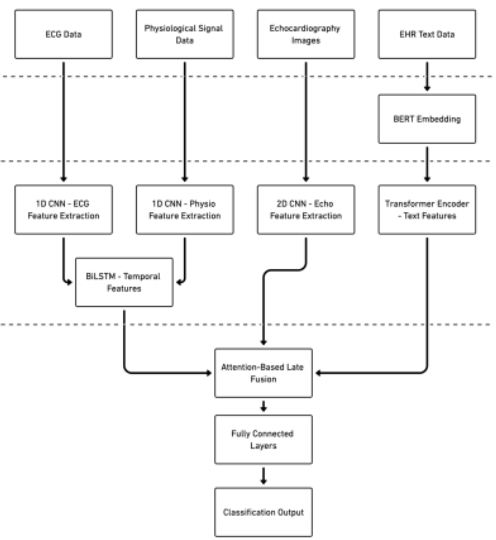
Congenital heart disease (CHD) is the most common congenital defect and still adds significantly to the neonatal morbidity and mortality rates. Classic echocardiography and ECG unimodal data traditional methods are often unable to analyze complex, multifunctional, and multifactorial cardiac pathologies in neonates. This paper presents an explainable multimodal deep learning framework that acquires four diverse sources of clinical data. Multimodal data includes echocardiogram videos, ECG, and other physiological and structured electronics health record (HER) data. We propose a self-attention-based late fusion transformer architecture that also uses self-attention mechanisms. The model trains and validates on benchmark datasets, which are transparently and reproducibly available (EchoNet-Dynamic, MIMIC-IV, PhysioNet Capnobase, and MIT-BIH). The results achieved using the proposed model mark an improvement over existing benchmarks with 93% accuracy, 95% sensitivity, and 0.96 area under the ROC curve. Using interpretability modules, features that were value added towards determining the diagnostic indicators that were incorporated in the neonatal infant care were shown to be critically relevant. Moreover, the model shows high performance consistency across several data sources and shifts. The research illustrates the use of explainable deep learning architectures for automation of early-stage heart defect detection in newborns. Some of the future work includes validation through clinical studies and multilingual electronic health record integration.Downloads
References
WHO, “Congenital disorders,” https://www.who.int/health-topics/congenital-anomalies#tab=tab_1. Accessed: May 31, 2025. [Online]. Available: https://www.who.int/health-topics/congenital-anomalies#tab=tab_1
J. I. E. Hoffman and S. Kaplan, “The incidence of congenital heart disease,” J Am Coll Cardiol, vol. 39, no. 12, pp. 1890–1900, Jun. 2002, doi: 10.1016/S0735-1097(02)01886-7.
Y. Zhang et al., “Current status and challenges in prenatal and neonatal screening, diagnosis, and management of congenital heart disease in China,” Lancet Child Adolesc Health, vol. 7, no. 7, pp. 479–489, Jul. 2023, doi: 10.1016/S2352-4642(23)00051-2.
S. A. Yoon, W. H. Hong, and H. J. Cho, “Congenital heart disease diagnosed with echocardiogram in newborns with asymptomatic cardiac murmurs: a systematic review,” BMC Pediatr, vol. 20, no. 1, pp. 1–10, Jun. 2020, doi: 10.1186/S12887-020-02212-8/TABLES/6.
D. B. Olawade, N. Aderinto, G. Olatunji, E. Kokori, A. C. David-Olawade, and M. Hadi, “Advancements and applications of Artificial Intelligence in cardiology: Current trends and future prospects,” Journal of Medicine, Surgery, and Public Health, vol. 3, p. 100109, Aug. 2024, doi: 10.1016/J.GLMEDI.2024.100109.
X. Xu et al., “A Comprehensive Review on Synergy of Multi-Modal Data and AI Technologies in Medical Diagnosis,” Bioengineering 2024, Vol. 11, Page 219, vol. 11, no. 3, p. 219, Feb. 2024, doi: 10.3390/BIOENGINEERING11030219.
F. Lopez-Jimenez et al., “Artificial Intelligence in Cardiology: Present and Future,” Mayo Clin Proc, vol. 95, no. 5, pp. 1015–1039, May 2020, doi: 10.1016/J.MAYOCP.2020.01.038,.
P. ; Pachiyannan et al., “A Novel Machine Learning-Based Prediction Method for Early Detection and Diagnosis of Congenital Heart Disease Using ECG Signal Processing,” Technologies 2024, Vol. 12, Page 4, vol. 12, no. 1, p. 4, Jan. 2024, doi: 10.3390/TECHNOLOGIES12010004.
P. N. Jone et al., “Artificial Intelligence in Congenital Heart Disease: Current State and Prospects,” JACC: Advances, vol. 1, no. 5, Dec. 2022, doi: 10.1016/J.JACADV.2022.100153,.
K. Khan, F. Ullah, I. Syed, and H. Ali, “Accurately assessing congenital heart disease using artificial intelligence,” PeerJ Comput Sci, vol. 10, pp. 1–43, 2024, doi: 10.7717/PEERJ-CS.2535,.
M. Cheng et al., “Development and Validation of a Deep-Learning Network for Detecting Congenital Heart Disease from Multi-View Multi-Modal Transthoracic Echocardiograms,” Research, vol. 7, p. 0319, Jan. 2024, doi: 10.34133/RESEARCH.0319.
D. B. Olawade, N. Aderinto, G. Olatunji, E. Kokori, A. C. David-Olawade, and M. Hadi, “Advancements and applications of Artificial Intelligence in cardiology: Current trends and future prospects,” Journal of Medicine, Surgery, and Public Health, vol. 3, p. 100109, Aug. 2024, doi: 10.1016/J.GLMEDI.2024.100109.
A. Bhattacharya et al., “Multi-modal fusion model for predicting adverse cardiovascular outcome post percutaneous coronary intervention,” Physiol Meas, vol. 43, no. 12, Dec. 2022, doi: 10.1088/1361-6579/AC9E8A.
“Multimodal Data Analysis and Fusion of Dynamic Physiological Signals and Electronic Health Records - Physiological Measurement - IOPscience.” Accessed: Jun. 04, 2025. [Online]. Available: https://iopscience.iop.org/journal/0967-3334/page/Multimodal-Data-Analysis-and-Fusion-of-Dynamic-Physiological-Signals-and-Electronic-Health-Records
X. Jacquemyn, S. Kutty, and C. Manlhiot, “The Lifelong Impact of Artificial Intelligence and Clinical Prediction Models on Patients With Tetralogy of Fallot,” CJC Pediatric and Congenital Heart Disease, vol. 2, no. 6Part A, p. 440, Dec. 2023, doi: 10.1016/J.CJCPC.2023.08.005.
R. Kabir et al., “Deep learning for clinical decision-making and improved healthcare outcome,” Deep Learning in Personalized Healthcare and Decision Support, pp. 187–201, Jan. 2023, doi: 10.1016/B978-0-443-19413-9.00004-7.
S. Thakur, V. K. Garg, and A. V. Kumar, “Role of artificial intelligence in the early detection of thrombocytopenia: An approach to improve health of pregnant women,” Proceedings - 2024 6th International Conference on Computational Intelligence and Communication Technologies, CCICT 2024, pp. 350–355, 2024, doi: 10.1109/CCICT62777.2024.00064.
P. Bizopoulos and D. Koutsouris, “Deep Learning in Cardiology,” IEEE Rev Biomed Eng, vol. 12, pp. 168–193, 2019, doi: 10.1109/RBME.2018.2885714,.
A. L. Goldberger et al., “PhysioBank, PhysioToolkit, and PhysioNet: components of a new research resource for complex physiologic signals.,” Circulation, vol. 101, no. 23, 2000, doi: 10.1161/01.CIR.101.23.E215,.
S. Leclerc et al., “Deep Learning for Segmentation Using an Open Large-Scale Dataset in 2D Echocardiography,” IEEE Trans Med Imaging, vol. 38, no. 9, pp. 2198–2210, Sep. 2019, doi: 10.1109/TMI.2019.2900516.
D. Ouyang et al., “Video-based AI for beat-to-beat assessment of cardiac function,” Nature, vol. 580, no. 7802, pp. 252–256, Apr. 2020, doi: 10.1038/S41586-020-2145-8;TECHMETA=139,141;SUBJMETA=117,639,692,699,705,75;KWRD=CARDIOVASCULAR+DISEASES,COMPUTER+SCIENCE.
A. E. W. Johnson et al., “MIMIC-IV, a freely accessible electronic health record dataset,” Sci Data, vol. 10, no. 1, pp. 1–9, Dec. 2023, doi: 10.1038/S41597-022-01899-X;SUBJMETA=174,228,308,478,692,700;KWRD=EPIDEMIOLOGY,HEALTH+SERVICES,PUBLIC+HEALTH.
R. R. Selvaraju, M. Cogswell, A. Das, R. Vedantam, D. Parikh, and D. Batra, “Grad-CAM: Visual Explanations from Deep Networks via Gradient-Based Localization,” Proceedings of the IEEE International Conference on Computer Vision, vol. 2017-October, pp. 618–626, Dec. 2017, doi: 10.1109/ICCV.2017.74.
K. He, X. Zhang, S. Ren, and J. Sun, “Deep residual learning for image recognition,” Proceedings of the IEEE Computer Society Conference on Computer Vision and Pattern Recognition, vol. 2016-December, pp. 770–778, Dec. 2016, doi: 10.1109/CVPR.2016.90.
J. Lee et al., “BioBERT: a pre-trained biomedical language representation model for biomedical text mining,” Bioinformatics, vol. 36, no. 4, pp. 1234–1240, Feb. 2020, doi: 10.1093/BIOINFORMATICS/BTZ682.
Y. Lecun, L. Eon Bottou, Y. Bengio, and P. H. Abstract|, “Gradient-Based Learning Applied to Document Recognition”.
M. Ma, L. H. Sun, R. Chen, J. Zhu, and B. Zhao, “Artificial intelligence in fetal echocardiography: Recent advances and future prospects,” Int J Cardiol Heart Vasc, vol. 53, p. 101380, Aug. 2024, doi: 10.1016/J.IJCHA.2024.101380.
M. Raghu, C. Zhang, G. Brain, J. Kleinberg, and S. Bengio, “Transfusion: Understanding Transfer Learning for Medical Imaging”, doi: 10.5555/3454287.3454588.
K. R. Dufendach, A. Navarro-Sainz, and K. L. Webster, “Usability of human-computer interaction in neonatal care,” Semin Fetal Neonatal Med, vol. 27, no. 5, p. 101395, Oct. 2022, doi: 10.1016/J.SINY.2022.101395.
D. M. Leone, D. O’Sullivan, and K. Bravo-Jaimes, “Artificial Intelligence in Pediatric Electrocardiography: A Comprehensive Review,” Children, vol. 12, no. 1, Jan. 2025, doi: 10.3390/CHILDREN12010025,.
X. Jacquemyn, S. Kutty, and C. Manlhiot, “The Lifelong Impact of Artificial Intelligence and Clinical Prediction Models on Patients With Tetralogy of Fallot,” CJC Pediatric and Congenital Heart Disease, vol. 2, no. 6, pp. 440–452, Dec. 2023, doi: 10.1016/J.CJCPC.2023.08.005.
F. Luna-Perejón et al., “Reviewing Multimodal Machine Learning and Its Use in Cardiovascular Diseases Detection,” Electronics 2023, Vol. 12, Page 1558, vol. 12, no. 7, p. 1558, Mar. 2023, doi: 10.3390/ELECTRONICS12071558.
G. Sunil Kumar and P. Kumaresan, “Deep Learning and Transfer Learning in Cardiology: A Review of Cardiovascular Disease Prediction Models,” IEEE Access, 2024, doi: 10.1109/ACCESS.2024.3514093.
X. Liu et al., “Applications of artificial intelligence-powered prenatal diagnosis for congenital heart disease,” Front Cardiovasc Med, vol. 11, 2024, doi: 10.3389/FCVM.2024.1345761,.
S. Raj and N. Bayappu, “Multimodal Deep Learning in Medical Diagnostics: A Comprehensive Exploration of Cardiovascular Risk Prediction,” Prediction in Medicine: The Impact of Machine Learning on Healthcare, pp. 78–94, Oct. 2024, doi: 10.2174/9789815305128124010008.
M. Cheng et al., “Development and Validation of a Deep-Learning Network for Detecting Congenital Heart Disease from Multi-View Multi-Modal Transthoracic Echocardiograms,” Research, vol. 7, Jan. 2024, doi: 10.34133/RESEARCH.0319,
Downloads
Published
How to Cite
Issue
Section
License
Privacy Statement
How the International Journal of Electrical Engineering and Intelligent Computing (IJEEIC) collects, uses, and protects personal data
1. Our Commitment
The names and email addresses entered on this journal site are used exclusively for the stated purposes of this journal and are not made available for any other purpose or to any other party.
This statement explains what personal data IJEEIC collects through its website, why it is collected, and how it is protected. IJEEIC handles personal data in line with Indonesian Law No. 27 of 2022 on Personal Data Protection.
2. Data We Collect
3. How We Use Your Data
- To manage submissions, peer review, editing, and publication of articles.
- To communicate with authors, reviewers, and editors about manuscripts.
- To send journal notifications and announcements that users have subscribed to.
- To publish author names and affiliations with accepted articles.
- To compile anonymous statistics on journal use and readership.
6. Data Retention and Security
- Account data is kept for as long as the account is active, or until the user asks for it to be removed.
- Data related to published articles is kept permanently as part of the scholarly record.
- Access to the editorial system is restricted to authorized editorial staff, and the website is protected with secure connections (HTTPS).
7. Your Rights
- Access and correction: you can view and update your personal details at any time by logging in and editing your profile.
- Deletion: you can ask the editorial office to delete your account and personal data. Data linked to published articles cannot be removed from the scholarly record.
- Unsubscribe: you can stop receiving journal notifications from your profile settings.
8. Contact
Questions or requests about personal data can be sent to:
Editorial Office of IJEEIC
Department of Electrical Engineering, Faculty of Engineering, Universitas Khairun
Jl. Yusuf Abdulrahman No. 53, Gambesi, Ternate, North Maluku, Indonesia
Email: ijeeic.unkhair@gmail.com · Contact page